The UPSERT Conundrum: When to Merge and When to Hold Back
I've always found myself pondering the nuances of updating databases, particularly when it comes to the age-old question: how do I efficiently insert or update records without duplicating effort? The answer, in many cases, lies in the realm of UPSERTs and MERGE statements. But what's the difference between these two, and when should you use each?
The Basics: UPSERT and MERGE
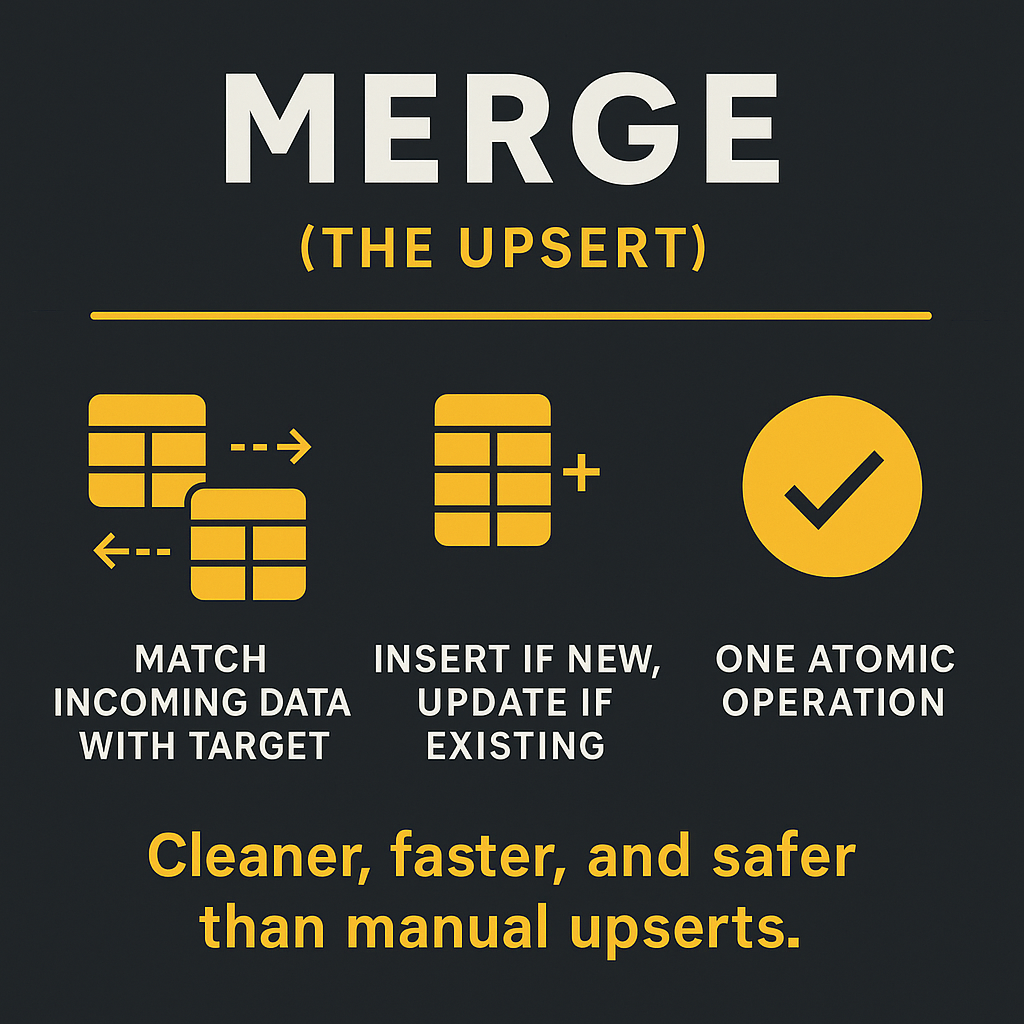
Let's start with the basics. An UPSERT, as the name suggests, contains two actions: it updates a record if it already exists, and inserts a new record if it doesn't. This sounds straightforward, but the devil's in the details. In many databases, UPSERTs are emulated using a combination of INSERT and UPDATE statements, often with some clever IF EXISTS logic thrown in for good measure. On the other hand, we have the MERGE statement, a specific SQL command supported in databases like Snowflake and SQL Server. MERGE performs an UPSERT based on a join condition, allowing you to specify which columns to match on and what actions to take when a match is found.
What's interesting here is that MERGE can be a powerful tool for synchronizing data between two tables. However, I suspect that many developers underestimate the performance implications of using MERGE on large tables. The truth is, MERGE can be a heavy operation, especially when dealing with millions of rows. This is because MERGE often involves locking rows or even entire tables, which can lead to contention and slow down your database. To mitigate this, I've found that filtering the source data before the merge can make a huge difference. By reducing the number of rows that need to be processed, you can significantly speed up the MERGE operation.
The Dark Side of MERGE
So, when should you avoid using MERGE? In my experience, massive datasets are often the culprit. When dealing with enormous amounts of data, the row-by-row locking overhead of MERGE can become a major bottleneck. This is where things get tricky. Instead of using MERGE, I've found that it's sometimes faster to insert new data into a staging table, create a new version of the target table by unioning the old data (excluding updated IDs) with the new data, and then swap the tables using an atomic swap. This approach may seem counterintuitive at first, but it avoids the locking overhead of MERGE and can be much faster in certain scenarios.
Here's the thing — this alternative approach requires some careful planning and execution. You need to ensure that the staging table is properly indexed, and that the union operation is optimized for performance. Additionally, the atomic swap needs to be done in a way that ensures data consistency and integrity. But when done correctly, this approach can be a game-changer for large-scale data updates.
NoSQL and Big Data Considerations
To put it simply, not all databases are created equal. In some NoSQL or big data tools, like older Hadoop ecosystems, true UPSERTs aren't natively supported. This means that you need to get creative with workarounds, such as using temporary tables or clever scripting. I think what's fascinating about this space is the diversity of solutions and trade-offs. Depending on your specific use case and database technology, you may need to choose between different UPSERT strategies, each with its own strengths and weaknesses.
For example, in some cases, you may be able to use a database's built-in UPSERT functionality, while in others, you may need to roll your own solution using custom code and temporary tables. The key is to understand the performance implications and trade-offs of each approach, and to choose the one that best fits your needs.
Reflections and Takeaways
As I reflect on my experiences with UPSERTs and MERGE statements, I'm reminded that there's no one-size-fits-all solution. Depending on the size and complexity of your dataset, you may need to choose between different approaches, each with its own strengths and weaknesses. What I find fascinating is the ongoing evolution of database technology and the creative workarounds that developers come up with to solve real-world problems. Whether you're dealing with massive datasets or simple updates, understanding the nuances of UPSERTs and MERGE statements can make all the difference in the world. So, the next time you're faced with an UPSERT conundrum, take a step back, consider your options, and choose the approach that best fits your needs.